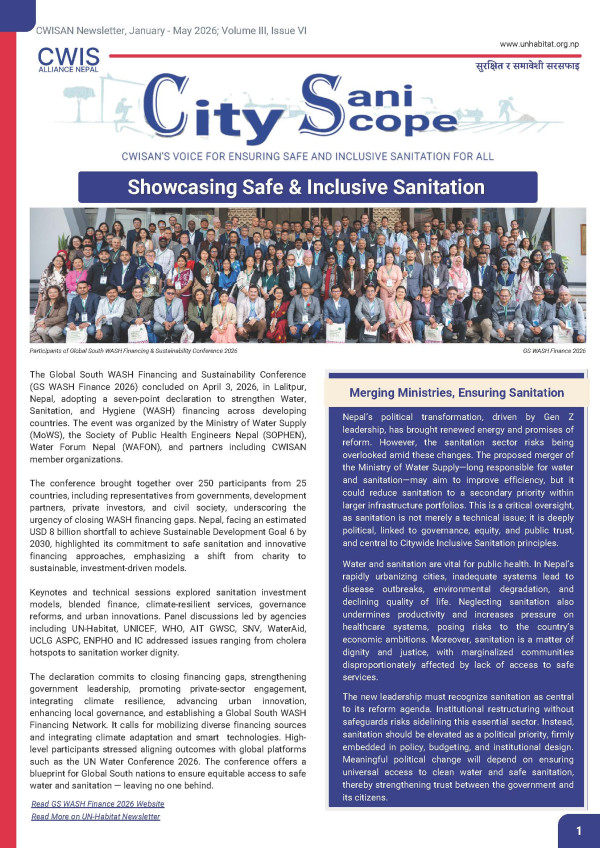
The UN-Habitat Nepal team is recognized as UN-Habitat 2026 Gender Champions!!!
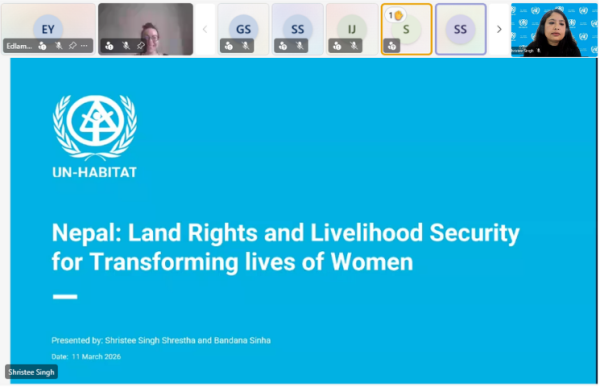
Kathmandu | 17 March 2026
This recognition celebrates a deliberate, intersectional
focus on ensuring all women—especially Indigenous women, Dalit women, and those
living in Informal Settlements—can securely access their land rights.
Commitment to Pro-Poor and Gender-Responsive Land Governance
UN-Habitat has partnered with the Government of Nepal to institutionalize pro-poor and gender-responsive land governance through various initiatives over a decade. The formulation of the 2019 National Land Policy, and piloted tools such as Fit-for-Purpose Land Administration (FFPLA) to identify, verify, and record landless and informal tenure households, and Joint Land Ownership (JLO) are some of the key results of this collaboration, which has been scaled nationwide, creating a stronger foundation for women’s land rights.
Empowering Women Through the L4ACT Project
The L4ACT project, “A safety net of innovative land tenure solutions for near-landless sharecroppers and for a greener rural Nepal,” funded by the Republic of Korea's Ministry of Agriculture, Food and Rural Affairs (MAFRA), has helped translate national policies into local action with tangible impacts.

- Real-World Gender Rights Impact
Securing land rights is a fundamental step toward true gender equality and is
foundational to ensuring no eviction and access to basic services. As of
December 2025, the L4ACT’s dedicated focus yielded tangible results in the
project:
- 23,494 applications from landless and informal settler
households were supported with temporary cards and integrated into the National
Land Commission Information System.
- 32 landless families received land ownership certificates, with 27 issued as joint ownership, strengthening women’s equal legal standing to land.
- 2,176 women - representing 80% of all participants - received training in climate-smart agriculture, enabling them to lead local green livelihood activities.
- Ms. Alice Harding Shackelford (Senior Advisor on UN System Coordination & Deputy Director, UN Women) highlighted the strong connection between access to justice and access to land, and echoed the clarion call for leaders to build upon existing commitments — reminding us that we are all leaders and must not remain silent in the face of discrimination. She emphasized that upholding gender equality is not only UN Women's responsibility, but that of the entire UN system, and expressed hope in collective action.
- Ms. Edlam Abera Yemeru (Chief of Knowledge and Innovation, UN-Habitat) emphasized the need to scale these impactful interventions and noted that this recognition is also an opportunity for continued learning across teams and the wider UN system.
- Ms. Sri H. Sofjan (Senior Programme Administrator & Strategist, Huairou Commission) reminded us that “we should celebrate Women’s Day every day” and congratulated the Nepal team for “opening a clear path for tens of thousands of women to access equal land rights.”
Ms. Pragya Pradhan (Habitat Programme Manager, UN-Habitat Nepal) emphasized the value of applying global tools and practices, citing the Global Land Tool Network (GLTN) as an example, and stressed the importance of adapting them to local contexts and scaling them across Nepal.