Global South WASH Finance Conference 2026: CWISAN Highlights Pathways to Sustainable Urban Sanitation Financing
Kathmandu | 8 April 2026
The Citywide Inclusive Sanitation Alliance Nepal (CWISAN)
with its Secretariat at the UN‑Habitat Nepal Office convened a high‑level
workshop titled “Unlocking Urban Sanitation Finance: Gaps, Models, and Scalable
Inclusive Solutions” during the second day of the Global South WASH Financing
& Sustainability Conference (GS WASH Finance 2026). The session was held on
2 April 2026 at The Plaza Convention Center and brought together policymakers,
regional sanitation alliances, development partners, and practitioners from
across the Global South.
The UN-Habitat/CWISAN workshop was chaired by Mr. Ramakanta Dawadi, Joint Secretary, Planning and Foreign Coordination Division, Ministry of Water Supply (MoWS), Government of Nepal. In his reflections, Mr. Dawadi emphasized that urban sanitation remains critically underfunded, noting that financing challenges extend beyond capital investments to include functionality, sustainability, and long‑term service delivery. He underscored the importance of systematically allocating resources for operation and maintenance (O&M) within WASH initiatives and called for stronger behavior change campaigns to build public demand and mobilize political leadership to prioritize sanitation financing.

The session featured a keynote address by Mr. Hezekiah Otieno Pireh, Water and Sanitation Team Leader, UN‑Habitat and CWISAN Secretariat representative. His presentation highlighted the scale of global and regional sanitation financing gaps, the high economic and social costs of inaction, and the urgent need for investment‑ready, citywide inclusive sanitation (CWIS) systems. He emphasized that the sanitation financing challenge is largely driven by enabling‑environment constraints rather than a lack of capital, calling for stronger political will, policy coherence, governance, and regulatory frameworks.
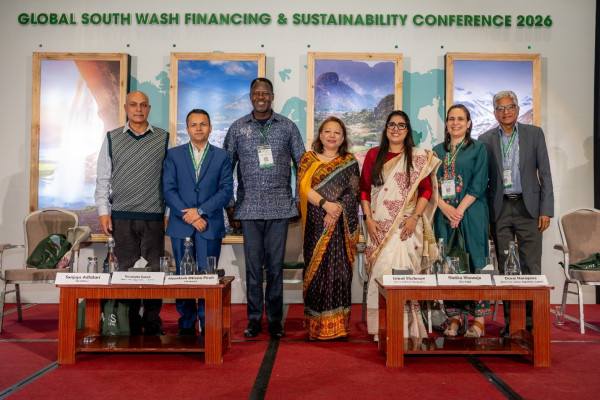
A distinguished panel of experts shared regional experiences
and practical financing approaches, including:
- Ms. Ishrat Shabnam, Country Director, Practical Action in
Bangladesh and Secretariat of the FSM Network, who presented Bangladesh’s
experience in developing scalable and inclusive financing models for fecal
sludge management.
- Ms. Snehalata Mekala, Associate Professor, Administrative
Staff College of India (ASCI) and National FSM Alliance (NFSSM) representative,
who highlighted India’s progress and challenges in scaling sustainable
sanitation systems.
- Mr. Dorai Narayana, Board Member, WaterLinks, who provided a
regulatory perspective on the role of tariffs, service standards, and
accountability mechanisms in enabling sanitation financing.
- Ms. Nadira Khawaja, Sector Leader – Water, SNV Development Organisation, who shared a development partner perspective on transitioning from project‑based funding toward system‑wide and blended financing approaches.
The discussion was moderated by Mr. Sanjaya Adhikary, WASH
Policy Advisor, UN‑Habitat Nepal, who guided the dialogue toward actionable,
scalable, and inclusive financing pathways relevant to diverse urban contexts
across the Global South.
The workshop concluded with strong consensus on the need to improve WASH budget utilization, strengthen institutional and regulatory frameworks, and foster regional collaboration and alliances to advance financially sustainable and inclusive urban sanitation services. Participants reaffirmed their commitment to working collectively toward achieving SDG 6 and ensuring that sanitation systems are not only built, but sustainably operated and equitably accessible.

Likewise, in another technical session titled “Public Leadership, Decision Making & WASH Financing Reform” on 2 April 2026 during GS WASH Finance 2026, Ms. Sudha Shrestha, National Programme Officer-WASH of UN‑Habitat, highlighted critical financing and performance gaps in urban sanitation across Nepal. Based on assessments in ten municipalities, her presentation underscored widespread underutilization of sanitation infrastructure, weak cost recovery, limited regulatory enforcement, and chronic underfunding of operations and maintenance, particularly in fecal sludge management systems. She noted that wastewater and sanitation continue to be underprioritized compared to water supply, putting national targets and SDG 6.2 and 6.3 at risk. Ms. Shrestha stressed that achieving equitable, citywide inclusive sanitation will require stronger institutional coordination, sustainable financing models, and pro‑poor approaches that ensure safe, functional services for all urban communities.

Similarly in another technical session titled “Strengthening
Governance Through WASH” on 2 April 2026, Mr. Sanjaya Adhikary, WASH Policy
Advisor of UN‑Habitat Nepal, emphasized that the water and sanitation sector
has reached a critical transition point where the challenge is no longer
access, but assuring service quality, reliability, and accountability. He
highlighted that weak regulation has allowed inconsistent performance -- particularly
in sanitation -- to become the norm, despite an existing legal and policy
framework. Mr. Adhikary stressed that operationalizing Nepal’s Water and
Sanitation Act 2022, WASH Policy 2023, and related regulations through
standardized benchmarks, performance monitoring, and transparent accountability
mechanisms is essential to strengthening governance and delivering safe,
equitable, and sustainable WASH services nationwide.