Beekeeping Opens New Livelihood Pathways for Landless Farmers in Dang
Kathmandu | 2 April 2026
For many landless and marginalized families in Nepal, securing a stable livelihood remains a constant struggle. Seasonal wage labor is often their main source of income, leaving households vulnerable to food insecurity and economic shocks. In this context, beekeeping is emerging as a practical and climate‑smart livelihood option -one that requires little land, modest investment, and can be managed from home.

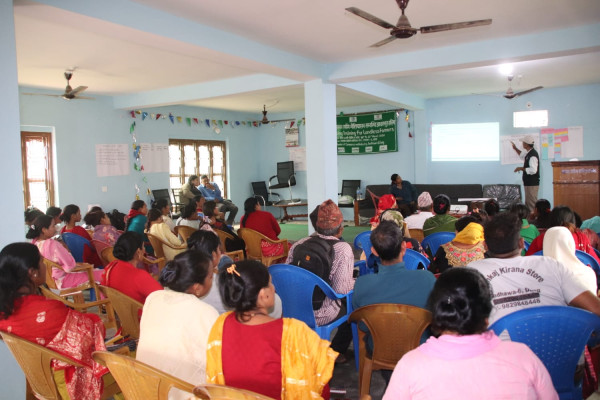
To promote this opportunity, UN‑Habitat as part of the ongoing project funded by Ministry of Food, Agriculture and Rural Affairs of Kores implemented a five‑days’ Basic Beekeeping Training for Landless Farmers in Dang district. The training was conducted from 16 to 22 March 2026 in partnership with Good Neighbors International (GNI) Nepal and the Community Self Reliance Centre (CSRC).

The training brought together 46 landless and marginalized farmers from three Self‑Help Groups including 21 from Thulichaur Land Right Forum of Gadhawa-5, 11 from Kalapani Land Right Farmer Group of Rapti-5, and 14 from Dandagaun Land Right Farmer Group from Gadhawa-2. Most of the participants had limited access to land and relied primarily on daily labor or remittances for livelihood. Women formed the majority of participants, with strong representation from youth and historically marginalized communities. For many, the training introduced a new way of thinking about livelihoods—one that do not depend on large landholdings or heavy physical labor.
“Before this training, we believed income generation was only possible if you had a lot of land,” shared one participant. “Now I understand that with proper use even a small piece of land can be productive.”

The sessions were facilitated by Beekeeping Specialist Rudra Mani Poudel, and a commercial beekeeper Ashok Kumar Sharma,. Over five days, participants gained practical knowledge on honeybee species, colony behavior, hive handling, seasonal flowering plants, feeding practices, and basic pest and disease management. The participants also joined an exposure visit to established beekeeping enterprises in Dang district, including a beekeeping firm, an individual bee farm, and a honeycomb manufacturing plant. Interacting with experienced entrepreneurs and observing commercial operations helped participants visualize beekeeping as a realistic livelihood opportunity.
