Innovative Land Solutions for a Greener, More Secure Rural Nepal
Dhulikhel | 13–14 November 2025
UN-Habitat Nepal convened a two-day Consultative Workshop on Strengthening Land Tenure Security, Inclusive Land Use Planning, and land-based Climate-Responsive Livelihoods on 13–14 November 2025 in Dhulikhel. The workshop forms part of the ongoing project, “A safety net of innovative land tenure solutions for near-landless sharecroppers and for a greener rural Nepal,” funded by the Ministry of Agriculture, Food and Rural Affairs (MAFRA) of the Republic of Korea. The event brought together national ministries, the four target municipalities from Deukhuri Valley, technical agencies, academia, civil society organizations, and community representatives to review mid-term progress and outline a strategic way forward.
 Habitat Programme
Manager, Pragya Pradhan, delivers a warm welcome to participants during the
opening session of the workshop.
Habitat Programme
Manager, Pragya Pradhan, delivers a warm welcome to participants during the
opening session of the workshop.
Opening remarks from the Ministry of Land
Management, Cooperatives and Poverty Alleviation and UN-Habitat emphasized the
project’s core ambition to reduce landlessness and enable climate-resilient,
land-based livelihoods among vulnerable Tharu, Yadav and other communities, and
supporting in land use planning for sustainable land management in Deukhuri
Valley of Dang District. Over the course of two days, participants shared
lessons from field implementation and discussed how secure tenure, stronger
local planning, and climate-smart agriculture can work together to build
resilience.
Community Self Reliance Centre (CSRC) presented experiences from the participatory process for land tenure security being implemented across the four municipalities. Through awareness-raising, community enumeration, multi-step verification and public hearings, households that have lived for years without formal documents are now on a pathway toward recognition of their land rights. Municipal representatives described how the process has strengthened trust between communities and local governments, while also highlighting bottlenecks such as limited legal clarity following the dissolution of the national land commission, and administrative challenges faced by households without documentation.
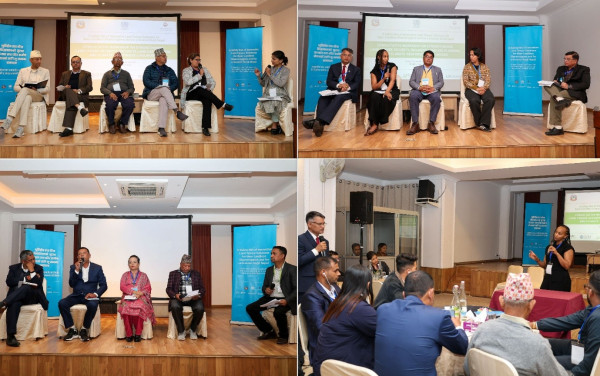
 Local, national, and
international experts deliver presentations during the workshop
Local, national, and
international experts deliver presentations during the workshop
Discussions on climate-smart agriculture
showed how livelihood activities are beginning to take root. Farmers’ groups
have been engaged in training, livelihood planning and collective farming, with
new crop varieties and improved practices introduced in areas exposed to
drought and flooding. Participants shared stories of farmers testing ground
nuts, sweet potatoes and other resilient crops, as well as adopting improved
cookstoves and small-scale irrigation support that help reduce both workload
and climate risks. These early efforts, they noted, are strengthening
confidence and demonstrating how secure land rights and climate-sensitive
farming can reinforce each other.
Land use planning sessions, supported by UN-Habitat’s Urban Lab, highlighted the importance of tenure-responsive and risk-sensitive approaches for fast-changing rural municipalities. Partners from Rajdevi Engineering Consultant, the Korea Rural Economic Institute (KREI), and Korea Land and Geospatial Informatix Corporation (LX) shared insights from their assessments and technical support, highlighting the need for better spatial data, clearer land classifications, and tools that local planners can easily apply. With agricultural land increasingly pressured by urban expansion and infrastructure development, participants emphasized safeguarding productive farmland and integrating climate and hazard considerations into municipal planning.
 Government
representative stakeholders engage in focused group discussions during the
workshop
Government
representative stakeholders engage in focused group discussions during the
workshop
Throughout the workshop, a recurring theme
was the value of collaboration. The project’s model—linking land tenure,
livelihoods and planning—has created opportunities for municipalities, line
agencies, civil society and communities to work together in ways not previously
common. Participants agreed that continued joint efforts will be essential to
address persistent constraints, including legal ambiguities, limited technical
capacity, and the need for stronger institutional arrangements at the local
level.
The workshop concluded with a shared commitment to complete the ongoing tenure processes, expand climate-responsive livelihood demonstrations, and support municipalities to integrate secure tenure and resilience considerations into their land use plans. Stakeholders also recommended piloting emerging ideas such as land consolidation and land banking, enhancing gender inclusion, and developing knowledge products to capture lessons for replication.
 Workshop participants
gather for a group photo
Workshop participants
gather for a group photo
As the project enters its second phase, the Dhulikhel workshop reaffirmed that secure land, resilient livelihoods and inclusive planning are mutually reinforcing pillars of sustainable development across rural-urban continuum. UN-Habitat and its partners — including MoLMCPA, local governments, KREI, LX, CSRC, GNI, GLTN and the Urban Lab — will continue to work closely to ensure that the benefits of land security and climate-smart agriculture reach the most vulnerable households in Nepal’s Deukhuri Valley, with the hope that the approach may be learning for rest of the municipalities in Nepal as well.
Photos: ©UN-Habitat Nepal/Hari Jang
Thapa