Hetauda Sub-Metropolitan City Hosts Workshop on Gender and Climate Responsive Urban Planning
Hetauda | 2 December 2025
Hetauda Sub-Metropolitan City successfully organized a
one-day orientation and testing workshop on the “Municipal Level Gender
Responsive and Climate Resilient Urban Planning Guideline” on 2 December 2025,
under the EU-funded Cities 4 Women: Inclusive and Climate Resilient
Urbanization in Nepal project. The workshop was facilitated by UN-Habitat in
collaboration with the Ministry of Urban Development (MoUD), UNOPS, and Cities
Alliance. It aimed to orient municipal stakeholders on the newly developed
guideline, test its practical applicability at the local level, and strengthen
local ownership for effective implementation.
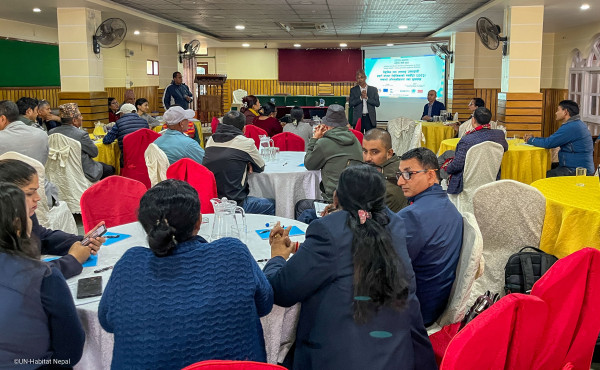
The event brought together 48 participants, including 20 women, comprising the Mayor, Chief Administrative Officer, ward chairpersons, and section heads from various municipal units. The program commenced with a welcome address by Ms. Pragya Pradhan, Habitat Programme Manager at UN-Habitat, who emphasized the importance of the guideline in enabling local governments to systematically integrate gender equality, social inclusion, and climate resilience into municipal urban planning processes.

The team of Experts presented the guideline’s key features, structure, and implementation steps, placing particular emphasis on mandatory Gender Equality and Social Inclusion (GESI) provisions, including social audits, citizen feedback mechanisms, and accountability tools. Participants actively engaged in the sessions, offering practical inputs and suggestions to further strengthen and contextualize the guideline for effective municipal application.

Ms. Mina Kumari Lama, Mayor of Hetauda Sub-Metropolitan City, shared the municipality’s vision of building a “Clean, Productive, and Prosperous Hetauda.” She highlighted ongoing initiatives aimed at creating a women-friendly, child-friendly, and disability-inclusive city, such as the plantation of over 30,000 trees with a target of 50,000, the implementation of women-focused skill development and income-generating programs, and continued collaboration with development partners to promote sustainable urban development.

The workshop also featured interactive group discussions during which participants identified Hetauda’s strengths, gaps, and key challenges related to local industries and livelihoods; access to safe drinking water and sanitation; electricity and internet services; health facilities; road and drainage infrastructure; public spaces; and support mechanisms for vulnerable groups. These discussions generated valuable, ground-level insights that will inform future planning and support the practical application of the guideline within the municipality.

The workshop concluded with closing remarks by Senior
Divisional Engineer Mr. Mahesh Bahadur Singh of MoUD, who highlighted the
challenges of rapid urbanization and reaffirmed the Ministry’s support for
gender-responsive and climate-resilient urban development, including blue-green
infrastructure initiatives.
The event successfully enhanced municipal stakeholders’
understanding and ownership of the guideline, identified local priorities and
gaps, secured strong commitment from elected representatives to apply
it—especially for inclusive public open spaces—and gathered valuable feedback
to refine the document. This marks an important step forward in promoting
inclusive, gender-sensitive, and climate-resilient urban planning in Nepal,
made possible through the joint efforts of UNOPS, UN-Habitat, Cities Alliance,
and MoUD.