From Fallow Land to Food Security: Story from Thulichaur, Gadhawa
Dang | 3 September 2026
In the remote village of Thulichaur, Gadhawa Rural Municipality-5, rice farming was long considered impossible. Uneven terrain and the complete absence of irrigation made traditional paddy cultivation unfeasible, while the impacts of climate change further exacerbated these challenges. For years, farmers left their plots fallow and bought rice from the market – a costly dependence for a community that relies on rice as a dietary staple. Erratic rainfall had repeatedly destroyed earlier attempts, leaving little hope that rice could ever grow here.
That began to change with
the Climate-Smart Agriculture (CSA) initiative under the A Safety Net of
Innovative Land Tenure Solutions for Near-Landless Sharecroppers and for a
Greener Rural Nepal (L4ACT) project. The project introduced 84 kg of Sukha
Dhan-3 – a drought-tolerant paddy variety introduced by the Nepal Agricultural
Research Council (NARC) to 22 members of the Thulichaur Land Right Farmer
Group, Gadhawa Rural Municipality-5. The seeds covered 1.87 hectares of
previously unused land. Alongside the input support, farmers received practical
training in climate-resilient cultivation techniques, including improved seed
sowing, land preparation, and water-efficient practices suited to the local
geography and climate.
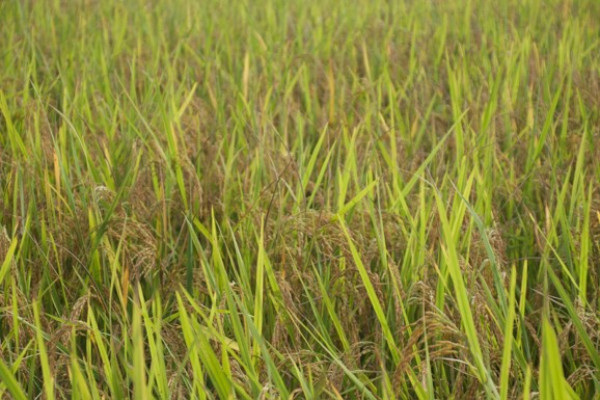
Sukha Dhan-3 is known for its ability to withstand drought and its resistance to blast and bacterial leaf blight. Guided by the project team, the farmers planted the variety on plots that had been idle for years.

Farmers harvesting Sukha Dhan
The results exceeded expectations. Sak Bahadur Sunar, Chairperson of the Thulichaur Land Right Farmer Group, recalled: "Before the project interventions, we never imagined growing rice here. But with the Sukha Dhan-3 seeds and the training we received, we successfully harvested 1.5–2 quintals from just 1 katha of land. The panicles were long and healthy, and the plants grew tall even in dry conditions. This variety truly adapts to drought."

Sak Bahadur Sunar
"Sukha Dhan is a
promising rice variety for farmers, particularly in areas where irrigation
water is limited or rainfall is uncertain. It can help farmers reduce the risk
of crop failure and maintain production even under dry conditions. I encourage
farmers to consider Sukha Dhan as a climate-smart option, along with proper
crop management and timely planting." Fulandevi Chaudhary, Agriculture
Technician, Gadhawa Rural Municipality
On average, each group
member harvested five to six quintals of rice. The yield provided food security
for six to seven months – an important shift for households that had previously
relied entirely on purchased rice. The market price of Sukha Dhan ranges from
approximately NPR 2,700 to NPR 3,300 per quintal, depending on grain quality,
location, and prevailing market conditions.
The success of Sukha Dhan-3 has given the Thulichaur farmers both grain and confidence. They now plan to continue rice cultivation in future seasons. What the CSA programme delivered was more than a new seed variety: it demonstrated that with the right technical support and collective action, even challenging, rainfed landscapes can become productive farmland.
The farmers had preserved
seeds of the Sukha Dhan variety and are currently cultivating paddy on
approximately 15 kattha of land. With support from the MAFRA-CSA programme,
they now have access to irrigation facilities, enabling them to cultivate the
land more reliably.