Birendranagar Training Tests Municipal Urban Planning Training Manual
BIrendranagar | 11-12 August 2026
A two-day Municipal Urban Planning Guideline Training Manual
Testing was held in Birendranagar on 11–12 August 2026, bringing together 42
municipal elected representatives and officials, including the mayor, deputy
mayor, municipal executive members, chief administrative officer, and technical
and non-technical staff.
The training was organised to test the draft manual developed to support the implementation of the Municipal Urban Planning Guideline and to collect practical feedback from local government stakeholders. The initiative is part of efforts to strengthen inclusive and climate-resilient urban planning at the local level, with the engagement of UN-Habitat, UNOPS and Cities Alliance, and support from partners including the European Union and the Government of Finland.

Om Dharananda Rajopadhyay, Urban Planning Expert sharing during his session
The training covered key components of the local-level urban
planning process, including its phases, stages and activities, as well as the
policy, legal and institutional framework for urban planning in Nepal.
Participants also explored strategy formulation and priority setting and
discussed integrating gender equality, disability and social inclusion (GEDSI),
inclusive planning and climate resilience into municipal planning.
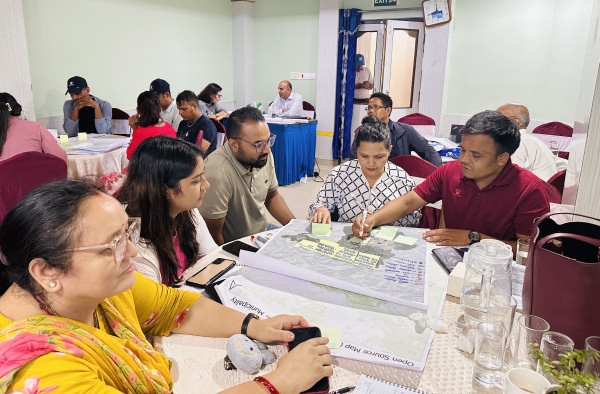
The training used a combination of presentations, group
discussions, questions and answers, reflection and practical exercises.
Participants actively engaged with the content and raised important questions
regarding the practical application of the guideline. Discussions highlighted
the need to clarify the relationship between the Municipal Urban Planning
Guideline and other local planning frameworks, while participants also raised
the question of how land pooling could be incorporated into the proposed urban
planning activities.
A pre-test was conducted at the beginning of the training to understand participants' existing knowledge, followed by reflection and feedback sessions throughout the training. These activities provided an opportunity to assess the clarity and applicability of the training content while identifying areas requiring further explanation and improvement.

Participants actively engage in group work
The training therefore served not only as a
capacity-building event but also as a practical validation exercise for the manual
and urban planning guideline. Questions, group discussion findings and
participant reflections generated valuable recommendations for improving the
clarity, coherence and practical applicability of the materials from elected
representatives of Birendranagar Municipality.
Gaj Bahadur Budha, Ward Chairperson of ward no. 2, said,
"I feel I can be a trainer. The subject of this training is sensitive but
important. Concepts such as GEDSI, urban planning, inclusive planning and
climate resilience are not new to us, but their incorporation into local-level
planning is crucial."
Mira Pant, Ward Member, ward no. 6, said, "Today's agenda and planning decision would impact what we achieve in the next 30 years. This is the biggest lesson I have learnt. The inclusion of elected representatives and government officials in this training is very important."

Mohan Maya Dhakal, Mayor of Birendranagar Municipality provides her closing remarks
During the concluding session, Mayor Mohan Maya Dhakal
emphasised the importance of applying the learning in the municipality's future
urban planning. "As the capital city of Karnali Province, Birendranagar
has significant opportunities to demonstrate how inclusive and
climate-resilient urban planning can support sustainable and people-centred
urban development. The training also reinforced the importance of engaging
elected representatives alongside municipal technical and non-technical
officials in strengthening local planning processes," she said.
The recommendations generated through the training will
contribute to the revision and finalisation of the Municipal Urban Planning
Guideline training manual, supporting future capacity development and wider
application of the urban planning process across local governments in Nepal.